

“From an infection perspective, we are in great shape with extremely low testing positivity rates,” said Bernadette Boden-Albala, dean of the new public health school at the University of California, Irvine.
There are currently about 35 COVID-19 cases reported each day on average in Orange County, marking the lowest levels seen in the region since March 2020, and a drastic drop from the 3,500 average cases seen during the January peak.
Testing positivity, or the percent of residents currently testing positive for the virus, hit a new low of 0.8% last week.
COVID-related hospitalizations are also at record lows, with just 76 patients being treated in the area’s hospitals as of early last week, down from the peak of 2,259 hospitalizations in the first week of January.
The county has also made significant strides in targeting virus transmission in harder-hit areas like Anaheim and Santa Ana.
At one point, those two cities were responsible for more than one-third of total cases reported in the county; in the past two weeks, Anaheim had just 1.5 new cases reported per 100,000 residents while Santa Ana has had about 1.3 average new cases.
Plateau
After an aggressive initial rollout, vaccine adoption in Orange County appears to have plateaued, with just about half of eligible residents and workers fully inoculated to date; while 55% have received at least one dose.
Boden-Albala warns that could bring about a case increase for the region this summer if one of the coronavirus variants that have hit other states and countries makes its way to the area.
“We have a vaccine surplus locally, and we should be further along in our trajectory,” Boden-Albala said.
Boden-Albala notes that while the forthcoming June 15 reopening date for California issued earlier this year by Gov. Gavin Newsom is a bright spot for the economy and residents, “it would feel more comfortable if we were closer to 70% immunization when that date comes,” Albala said.
Herd immunity to the coronavirus likely requires 70%-80% of the population to be vaccinated, according to most public health officials.
“At 50%, we still have a large risk not only for case outbreaks, but each person that isn’t vaccinated that gets COVID-19 could be a host to a variant,” such as the more contagious variant first seen in India that has since been detected in the United States.
Health officials have stated that vaccines are likely to protect against new variants.
Roughly 15,000 vaccines were administered each day in OC as of last week, compared to about 40,000 doses a month ago.
National health experts note that while regions could see a case increase this summer as vaccines continue to roll out, it’s not likely to be a significant surge like the two seen in Orange County last summer and winter.
“We are seeing that our current vaccines are protecting against the contaminant variants circulating in the country. Simply put, the sooner we get more and more people vaccinated, the sooner we will all get back to normal,” said Dr. Rochelle Walensky, director of the Centers for Disease Control, during a White House press briefing earlier this month.
Vaccination Efforts
The county could be doing more when it comes to vaccine distribution to avoid a future case surge, notes Boden-Albala, specifically in hot spot neighborhoods like those in North County.
A state database indicates that as of last week, there were 3 million vaccine doses administered in Orange County, including both residents and workers that might not live within the county.
About 1.4 million individuals were fully vaccinated within the county as of May 19, according to the OC Health Care Agency.
That represents about 44% of the county’s nearly 3.2 million population. About 10% of OC residents are under the age of 12 and not currently eligible for the vaccine.
“There’s been a gap in terms of underrepresented populations,” Boden-Albala said. “We need to be doing more to make sure these areas have access to the vaccine.”
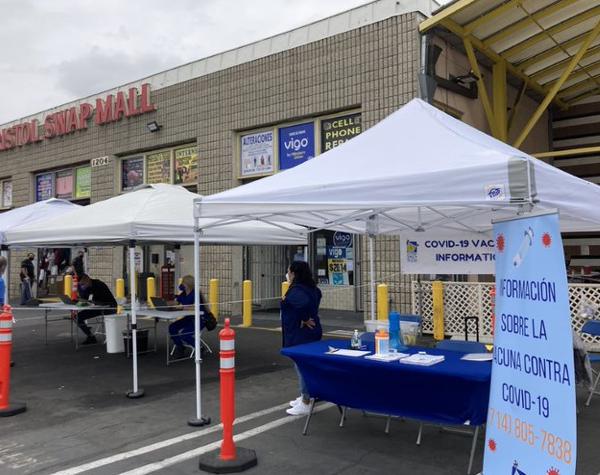
The county has set up five mass vaccine distribution sites since January, including three in Anaheim and Santa Ana, though each site is scheduled to close in June as the county works toward a full reopening.
“A lot has been done, but we still need more manpower going to those communities,” Boden-Albala said.
In a step in that direction, 360 Clinic, a Westminster-based COVID-19 testing partner for the Orange County Health Department, said on May 20 it had started offering free vaccinations at 20 of its 40-plus testing sites in Southern California.
The company, in partnership with the state’s third-party administrator Blue Shield of California, is focused on reaching vulnerable communities through mobile units staffed with multilingual medical professionals.
“Blue Shield was looking for an effective, scalable way to deliver in-home vaccines to the elderly and underserved communities, so collaborating with 360 Clinic and our network of kiosks and mobile units was a natural fit,” CEO Vince Tien said in a statement.
“Our core concept and commitment is to activate solutions within the communities most operators cannot, or will not, reach.”
School Requirements
The other issue the county is facing when it comes to vaccination uptake is a sense of distrust, or “science denialism,” according to Boden-Albala, causing individuals to elect to not get the vaccine.
“I think more people should recognize the advanced science that went into getting this vaccine out quickly, and trust that it’s the right thing to do for the community,” said Boden-Albala, who has had first-hand experience with vaccine distribution efforts.
UCI is one of several local universities that is requiring students, faculty and staff coming to campus in the fall to be fully vaccinated.
“We are calling each and every student and walking them through how to get vaccinated if they haven’t already,” Boden-Albala said.
“It’s all to ensure we create a safe and healthy campus.”
